

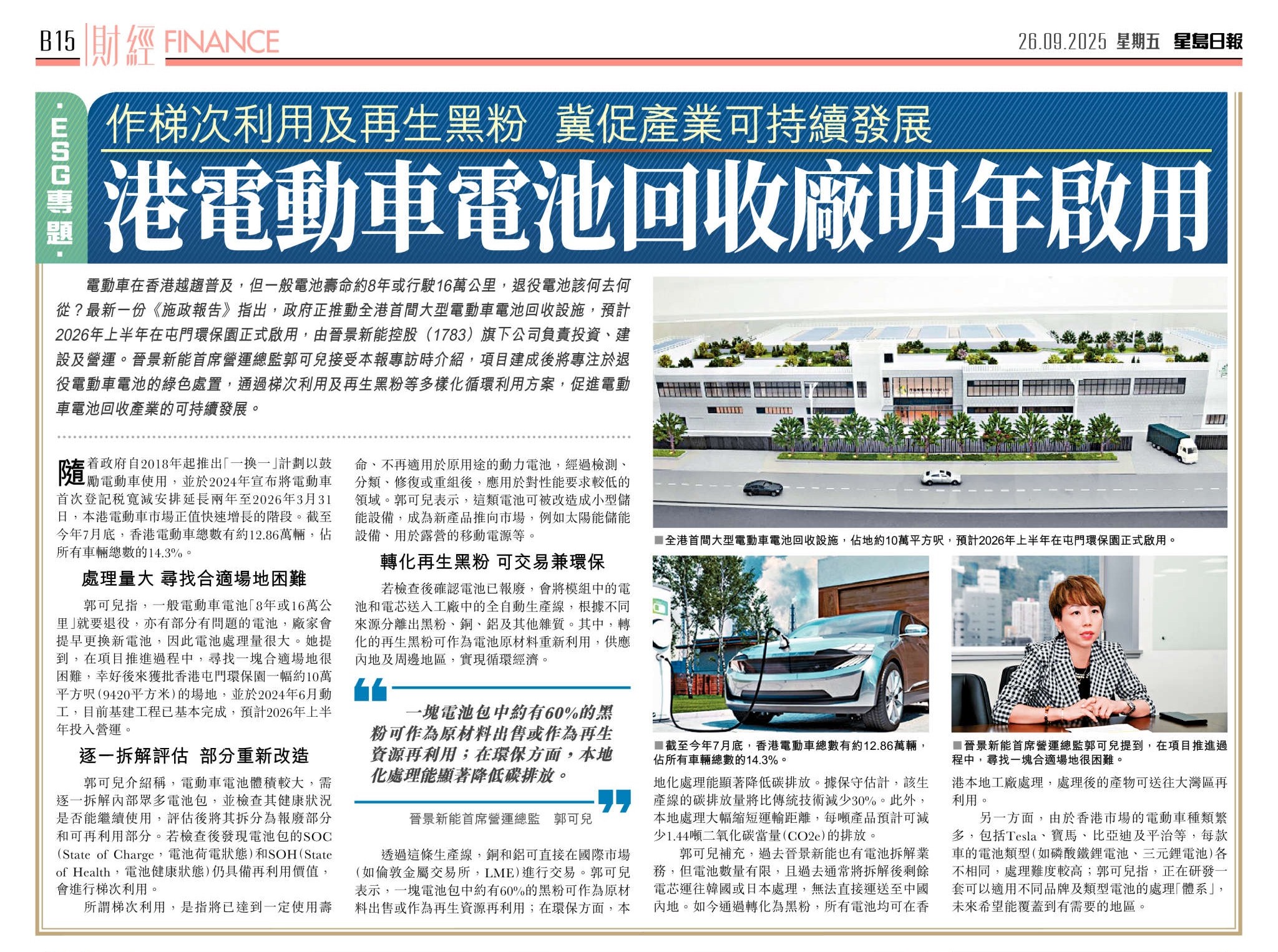
Electric vehicles are experiencing a marked increase in popularity within Hong Kong; however, the average lifespan of these batteries is approximately eight years or 160,000 kilometers. This raises the question of where these retired batteries are subsequently directed. The most latest Policy Address has revealed that the government is actively fostering the establishment of Hong Kong’s inaugural large-scale electric vehicle battery recycling facility, which is anticipated to commence official operations at the Tuen Mun EcoPark in the first half of 2026. This initiative is funded, constructed, and operated by a subsidiary of Envision Greenwise Holdings (1783.HK). In an exclusive interview with Sing Tao Daily, Ms. Kwok Ho Yee, Chief Operating Officer of Envision Greenwise, articulated that upon completion, the project will prioritize the environmentally responsible disposal of retired electric vehicle batteries, thereby promoting the sustainable development of the electric vehicle battery recycling sector through a variety of circular solutions such as second-life applications and the production of recycled black mass.
The Space Challenge of Industrial-Scale Battery Recycling
The government launched the “One-for-One Replacement” scheme in 2018 in favor of promoting the uptake of electric vehicles (EVs), in 2024, it was announced that the first registration tax concession for electric vehicles would be extended for two years to March 31, 2026. Hong Kong’s electric vehicle market is experiencing rapid growth, as of the end of July this year, there were approximately 128,600 electric vehicles in Hong Kong, accounting for 14.3% of the total number of vehicles.
Ms. Kwok Ho Yee remarked that, the batteries in electric vehicles (EVs) are generally retired after a span of “8 years or 160,000 km”. Additionally, certain problematic batteries are replaced earlier by manufacturers, resulting in a significant battery disposal volume. She further noted that the determination of a suitable site was one challenge that arose in the course of the project. Fortunately, they were latergranted a site covering around 100,000 square feet (9,420 square meters) at the Tuen Mun EcoPark in Hong Kong. Construction began in June 2024, the structural work is currently largely completed, and operations are expected to open in the first half of 2026.
From Sorting to Second Life: Repurposing Retired Batteries
Ms. Kwok explained that electric vehicle (EV) batteries are large in volume and must be dismantled into their distinct separate battery packs to assess their further usability. After the assessment, the collected batteries are sorted into sections that will be sent for scrapping and those found usable. If the battery pack’s State of Charge (SOC) and State of Health (SOH) indicate sufficient value for reuse, they are taken through second-life applications.
Second-life application is the process of recycling power batteries that have accumulated a specific service life and cannot be reused for the initial purpose. Through testing, sorting, repairing, or reassembly, these batteries can be repurposed for applications with lower performance demands. Ms. Kwok Ho Yee argued that these kinds of batteries can be transformed into small-scale energy storage products and commercialized as new products, including solar energy storage products or camping portable power supplies.
The Green Economy in Batteries
If the battery is found to be unsuitable for reuse after inspection, it will be sent to the fully automatic production line in the factory to separate black mass, copper, aluminum and other impurities. The recycled black mass can be reused as raw material for battery production and sent to the mainland and surrounding regions, promoting a circular economy.
With such a production line, the aluminum and copper can be directly marketed on the international exchange, such as the London Metal Exchange (LME). According to Ms. Kwok Ho Yee, roughly 60% of the battery pack is black mass, which can be sold as raw material or reprocessed as a recycled material. At the environmental level, local processing offsets carbon emissions effectively. Based on conservative estimates, the production line’s emissions will be lowered by 30% compared with conventional technology. Besides that, local processing effectively minimizes transportation distances, which can save emissions by as much as 1.44 tonnes of CO2e of product.
Ms. Kwok Ho Yee indicated that in the past, the company also had battery dismantling business; however, the number of batteries in Hong Kong was limited, and the remaining battery cells were typically shipped to South Korea or Japan for processing rather than being transported directly to mainland China. Now, by converting them into black mass, all batteries can be processed at local factories in Hong Kong, and the resulting products can be sent to the Greater Bay Area for reuse.
On the other hand, due to the wide variety of electric vehicles in the Hong Kong market, including Tesla, BMW, BYD, and Mercedes-Benz, each model has different battery types (such as LFP and NMC), which presents a higher level of processing difficulty. Ms. Kwok stated that the company is developing a system that can handle different brands and types of batteries, with the hope of extending its services to areas in need in the future.
Click below for the full report (Chinese version only):https://www.stheadline.com/esg/3502831/
